Public programme : “Im/mobile : counter-narratives of the space conquest”, a proposal by Oulimata Gueye
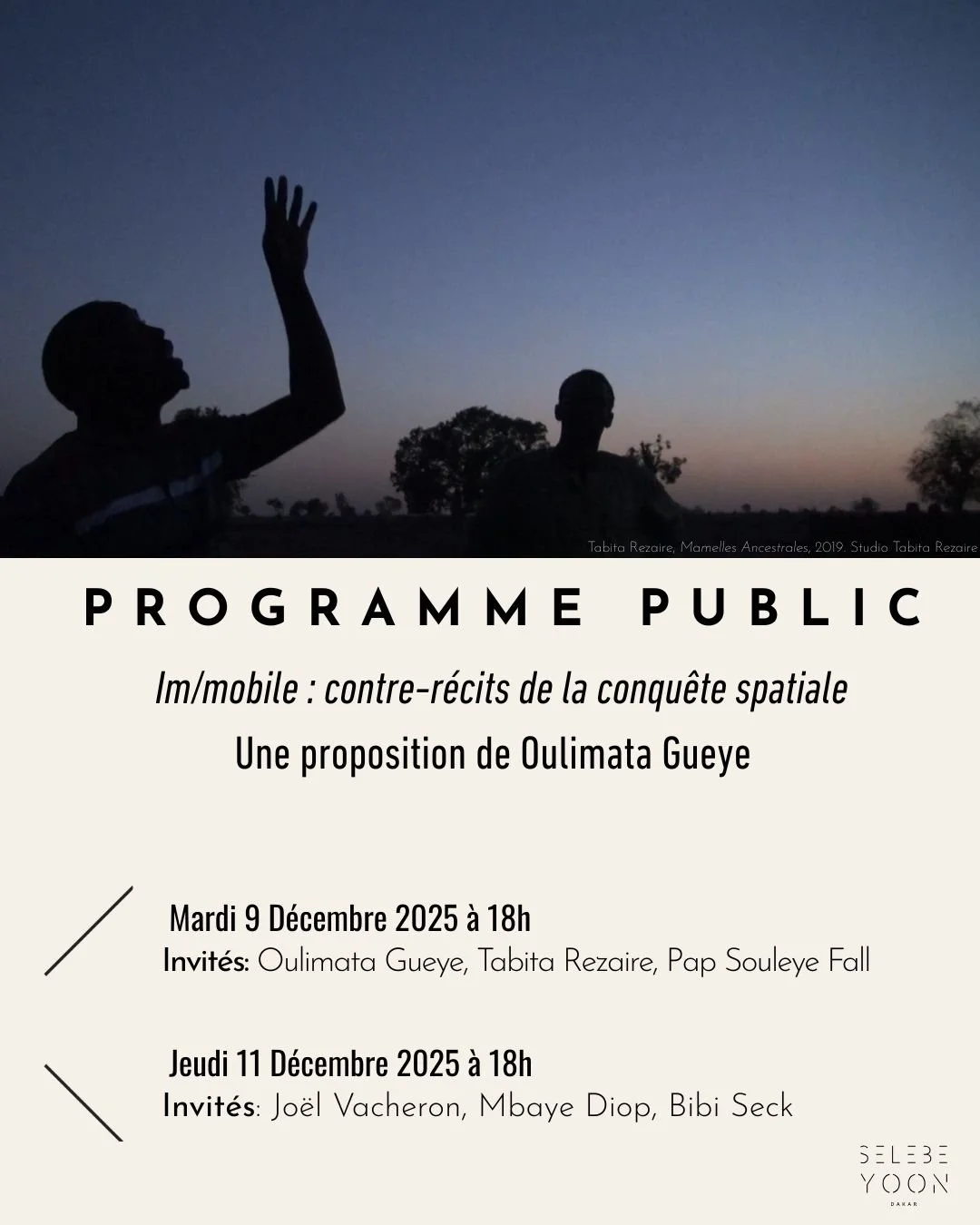
PUBLIC PROGRAMME
“Im/mobile: counter-narratives of the space conquest”
A proposal by Oulimata Gueye
On 6 June 1973, the three American astronauts who took part in the Apollo 17 mission paid an official visit to Senegal as part of their tour of Africa and Asia. On this occasion, they presented President Léopold Sédar Senghor with a fragment of lunar stone, which is now kept in the collection of the National Archives. Although relatively forgotten, this event nevertheless contributed in its own way to fuelling the myth of space exploration as a universal mission. As Joël Vacheron points out in Cosmovisions. A Visual Study of the Colonial Foundations of Space Exploration (MētisPresses, 2025), the Apollo programme was the first major media event of a globalised cosmology, where images of space — often reduced to their aesthetic beauty and scientific curiosity — served to maintain the illusion of their universality.
Much like the rest of the world, space research and industry represent a development challenge for the African continent. Nigeria, through its National Space Research and Development Agency (NASRDA), plans to send an astronaut into space in 2030. As for Senegal, in August 2024 it launched its first artificial satellite, the GAINDESAT-1A nanosatellite, designed in partnership with the Montpellier University Space Centre.
Yet, as the American firm SpaceX contemplates the relocation of humanity to outer space in the name of supposedly better habitability, and as space debris represents one of the most striking manifestations of orbital pollution, how should we critically view the history of the space conquest? Conceived in line with the artists' approaches and developed in collaboration with critic and curator Oulimata Gueye, this programme of encounters invites us to revisit the colonial foundations of space exploration with researcher Joël Vacheron, in order to reopen the field of planetary imaginaries. We will reflect on the following questions: what are the continental versions of the Western myth? How can we rehabilitate the long history of relations between scientific knowledge and celestial imaginaries maintained by African societies? How could contemporary technologies be linked to forms of spiritual and bodily knowledge?
Dates :
Tuesday 9 December, 6pm
Introduction by Oulimata Gueye, a Senegalese and French art critic and exhibition curator who teaches theory at the École des Beaux-Arts in Lyon. Her curatorial approach is based on research that brings together contemporary art, literature, popular culture and the history of science and technology.
Conversation with Tabita Rezaire & Pap Souleye Fall.
Thursday, 11 December, 6 p.m.
Presentation by Joël Vacheron of his book: Cosmovisions. A visual study of the colonial foundations of space exploration, (MētisPresses, 2025). Joël Vacheron holds a PhD in social sciences, teaches cultural studies, is an associate researcher at ECAL and co-founder of the Afropea Cultural Centre.
Conversation with Mbaye Diop & Bibi Seck.
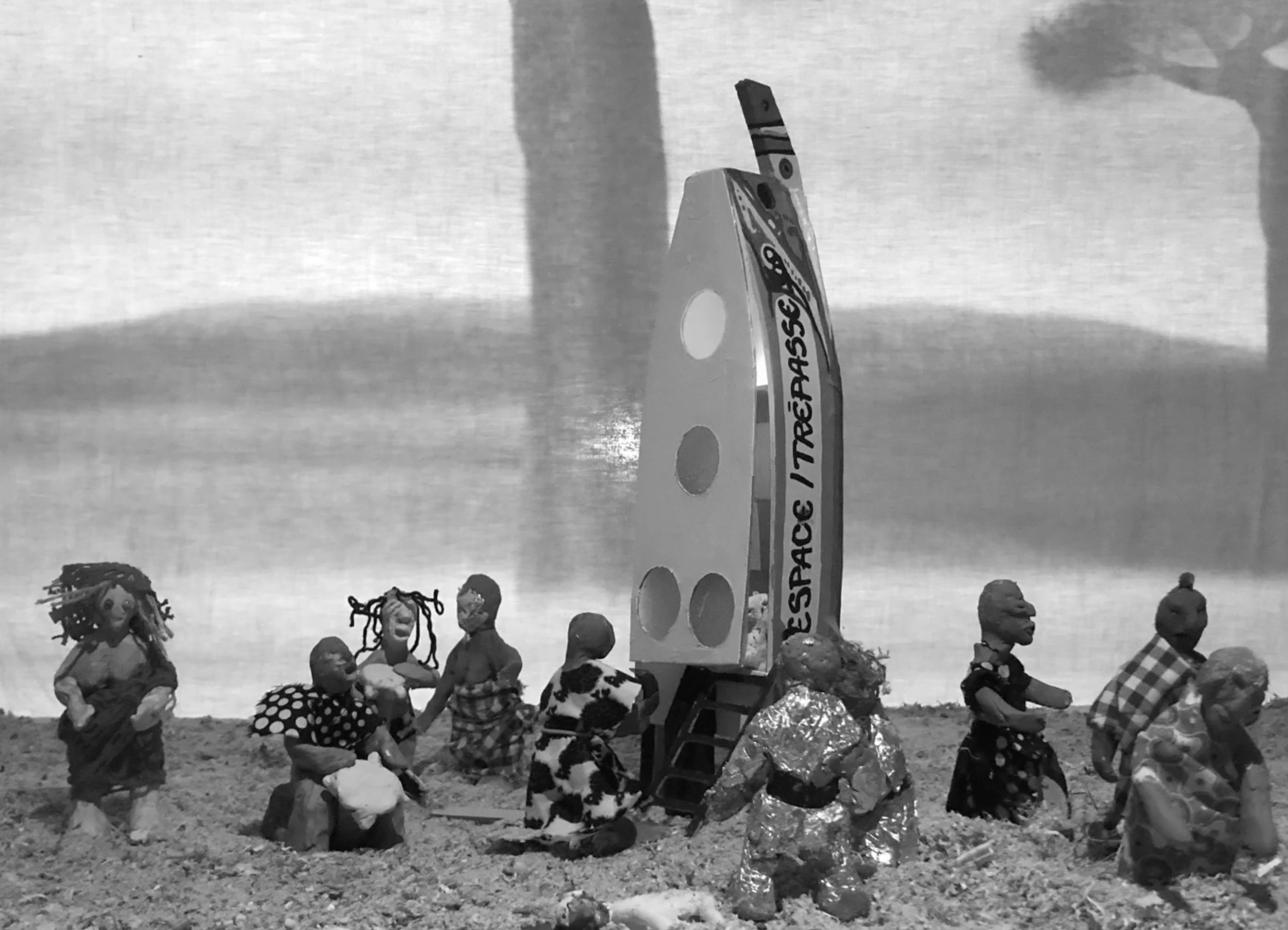
Mbaye Diop & Rémy Bender, Espace Trépasse, 2021 (film still). Courtesy the artists.
Participants
Oulimata Gueye is a Senegalese and French art critic and exhibition curator. Her work is based on research that combines contemporary art, literature, popular cultures and the history of science and technology. She has participated in numerous international projects focusing on electronic cultures, performance, experimental sound practices and media arts. She co-edited the book Digital Imaginaries. African Positions Beyond Binaries (ZKM-Kerber, 2021), and curated the exhibitions UFA – Université des Futurs Africains at Le Lieu Unique (2021) and Ars Memoriae at 601Artspace, New York (with Maarten Vanden Eynde, 2022). In 2023, she was a visiting researcher at the Canadian Centre for Architecture (CCA). She teaches at ENSBA Lyon. She is a member of the scientific committee of the Edouard Glissant Art Fund, AWARE's Women in AI and New Media Art programme, and the Steering Committee of the Museum of Black Civilisations in Dakar.
Joël Vacheron, PhD in social sciences, lives and works in Lisbon. His writings appear regularly in journals and magazines specialising in art, design and photography. Since 2013, he has been teaching cultural studies in the Visual Communication department at ECAL/HES-SO, where, as an associate researcher, he has co-directed projects exploring the impact of digitisation on creative processes. He is co-founder of the Afropea Cultural Centre and has published the book Cosmovisions. A Visual Study of the Colonial Foundations of Space Exploration (MētisPresses, 2025).
Tabita Rezaire has developed a multidisciplinary practice that explores the links between science, spirituality and new technologies. Her approach combines metaphysical and political perspectives to offer us new ways of understanding the world. Embracing digital, corporeal and ancestral memory, she digs into scientific imaginaries and mystical realms to tackle the colonial wounds and energetic misalignments that affect the songs of our body-mind-spirits. Tabita’s work is rooted in time-spaces where technology and spirituality merge as fertile ground to nourish visions for connection and emancipation. Through screen interfaces and healing circles, her offerings aim to nurture our collective growth and expand our capacity for togetherness. Tabita Rezaire is based in French Guiana, where she is caring for AMAKABA; a center for the arts of earth, body and sky. Tabita Rezaire’s works have been displayed at the Centre Pompidou, Paris; Palais de Tokyo, Paris; TBA, Madrid; Serpentine Gallery, London; MASP, São Paulo; MoMa, New York; New Museum, New York; Gropius Bau, Berlin; MAXXI Museum, Rome;; Museum of Contemporary Art, Chicago; Museo d'Arte Contemporanea Donnaregina, Naples; ICA, London; V&A, London; National Gallery Denmark; The Broad, Los Angeles; MoCADA, New York; Tate Modern, London; Musée d’art moderne, Paris. She has taken part in several international biennials (Havana, Gwangju, Sydney, Shanghai, Athens, Vienna, Kochi, Berlin), the Guangzhou Triennial and Performa, New York.
Pap Souleye Fall is a Senegalese-American artist who explores the transmedia potential between mediums including sculpture, installation, performance, cosplay, digital media, and comics. Growing up within the African Diaspora, Fall defines their approach as non-Western-centered, creating immersive environments that are joyful and evoke the Black imaginary. Their work is produced within the context of the African Diaspora. Being of two worlds and cultures, Fall delights in the ability to construct their own reality between the polarities of two widespread cultures. As such, Fall became fascinated with the ways art could be embedded in everyday life, activating common materials to explore themes such as utopia, identity, notions of masculinity, Africanisms, and Afro-Futurism. Their multidisciplinary practice often explores themes of speculative fiction. They hold an MFA in Sculpture from Yale School of Arts in New Haven, US (2022) and a BFA in Fine Arts from The University of the Arts in Philadelphia, US (2017). They have participated in numerous exhibitions including at ICA Maine, Maine, US (2025), Jack Barrett Gallery, New York, US (2025), Blade Study, New York, US (2025), Black Rock’s Residents Exhibition ”Encounters”, at Centre Blaise Senghor, Dakar, Senegal (2024), at Yale Art Gallery, New Haven US (2022), at the Yale Afro Centre, New Haven, US (2022), at Raw Material Company, Dakar, Senegal (2022).
Mbaye Diop has a masters in contemporary artistic practice from the HEAD School of Geneva in Switzerland as well as at the Beaux-Arts of Dakar. Diop is an attentive observer of the daily urban landscapes and architectural forms of Senegal and the socio-political movements that continuously redefine the links that exist between the African continent and the West. From video, performance, drawing, to installation, the singularity of his work lies in his exclusive and almost obsessive use of black and white, allowing him to neutralize the scenes represented. His work reveals the paradigm shifts currently at play in African societies, especially the dichotomy between tradition, urban infrastructures, and new technologies that tend to transform collective life and one’s relationship to the environment. His research portrays a country that is experiencing continuous growth, where colonial architecture, decaying buildings and urban cluttering intermingle. His conception of urbanity opens the way to a true geography of sociability spaces in the city. In 2010, he graduated from the National School of Arts in Dakar and taught visual arts in the city of Saint-Louis until 2019. He now lives and works in Switzerland and graduated with a master's degree in contemporary art practices at HEAD Geneva (Haute école d'art et de design) in 2022. He received the UEMOA prize for the Dakar Biennale in 2022; and the URTI/UNESCO prize for his radio project “Maam Kumba Bang“ in 2023. He has also been nominated for the Norval Sovereign African Art Prize in Cape Town, South Africa in 2023.
Bibi Seck, born Ibrahima André Seck, is a Senegalese multidisciplinary designer and artist based in Dakar. He began drawing at a very young age, and after studying automotive design in Paris at CREAPOLE-ESDI, he began his career at Renault, where he spent fourteen years designing car interiors for models such as the Scénic and Trafic. While working as an automotive designer at Renault, in the 1990s he imagined PAKKA CITY, a world suspended at an altitude of over 3,000 metres where the atmosphere is contaminated by a virus. In 2004, he founded the Birsel + Seck studio in New York with Ayse Birsel, combining automotive design and social reflection for international clients. His work is characterised by the presence of organic forms, humour and diverse artistic references. From 2006 onwards, he gradually reconnected with Dakar, where he eventually settled. There, he developed a new design practice involving Senegalese artisans and local materials. His ”Madame Dakar” sofa, made using traditional Senegalese weaving techniques for Moroso, was voted one of the 25 most influential pieces of furniture of the century by the New York Times. In his approach to design, he talks about ‘problem solving’ and not just style. In recent years, he has been promoting West African craftsmanship and championing the idea of democratised design. He currently runs the Quatorze Zéro Huit workshop and gallery in the centre of Dakar.