
Exhibition — “Amílcar Cabral: Toward a Radical Humanism” at MansA, Paris
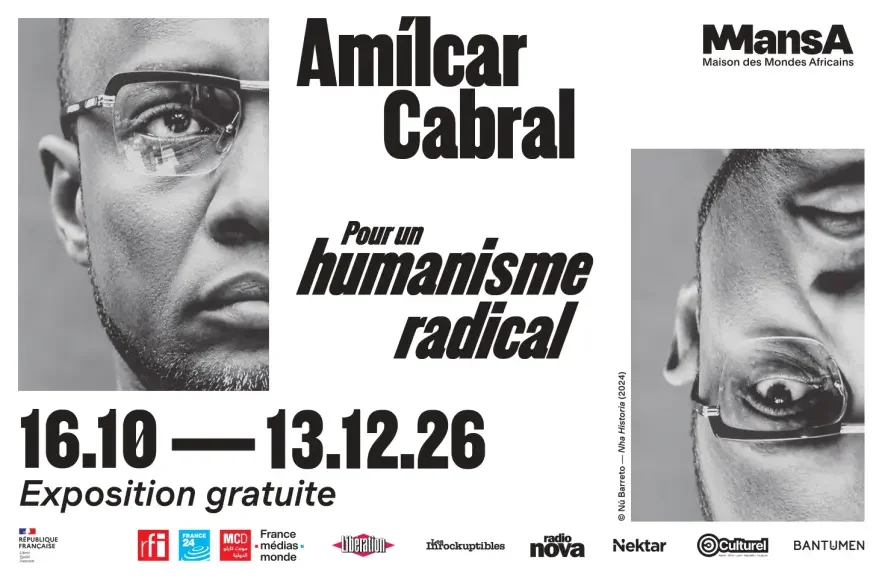
From October 16 to December 13, 2026, MansA, Paris, is dedicating an exhibition to Amílcar Cabral (1924–1973), a revolutionary, theorist, agricultural engineer, and leading figure in the African independence movements. Curated by Armelle Dakouo and Ângela Benoliel Coutinho, based on an original concept by Paula Nascimento, Amílcar Cabral: Toward a Radical Humanism creates a dialogue between his ideas and contemporary art through the works of nine artists from Portuguese-speaking Africa and beyond.
What else does Cabral have to say to us today?
More than fifty years after his assassination, Amílcar Cabral’s ideas continue to inform discussions on sovereignty, global inequalities, population displacement, and ecological crises. His approach—understanding the world in order to better transform it—and his conception of culture as a force for emancipation continue to provide tools for reflecting on the connections between culture, power, and freedom. For Cabral, national liberation is not limited to the achievement of political independence: it entails a profound transformation of societies, cultures, and consciousness. The land, art, and culture are not on the periphery of the political struggle, but at the very heart of building a new society. The exhibition explores the continued relevance of Cabral’s ideas by contrasting them with the perspectives of contemporary artists.
A Philosophy in Dialogue with Contemporary Art
The works of Nú Barreto, Diogo Bento, Filipa César, Monica de Miranda, Bento Oliveira, Hamedine Kane, Yuran Henrique, Sónia Vaz Borges, and Sarah Maldoror together form a living geography of what Cabral called a luta —the struggle. Bringing together artists from Guinea-Bissau, Cape Verde, Senegal, and Portugal, the exhibition creates a dialogue between textiles, photography, installation, video, and drawing, exploring concepts central to Cabral’s thought: identity, nation, belonging, and cultural resistance. Here, contemporary practices intersect with archives and cultural legacies. The films of Sarah Maldoror—a pioneering filmmaker and a committed figure in liberation struggles—play a particularly foundational role in the exhibition. Fogo, Île de Feu, Carnaval dans le Sahel, and A Bissau, Le Carnaval further explore the theme of culture as a space for reappropriation, memory, and resistance. Through their artistic visions, the nine invited artists do not seek to illustrate Cabral’s ideas but rather to engage in a dialogue with them, to expand on the questions they raise, or to reinvent their perspectives.The exhibition thus invites us to view Cabral not only as a major figure in African liberation struggles, but also as a body of thought to be brought back into circulation, confronted with the present, and engaged in dialogue with the creative works of our time.
On this occasion, Hamedine Kane created two new textile works honouring both Amílcal Cabral and Sarah Maldoror.