Fair - Frieze London 2026
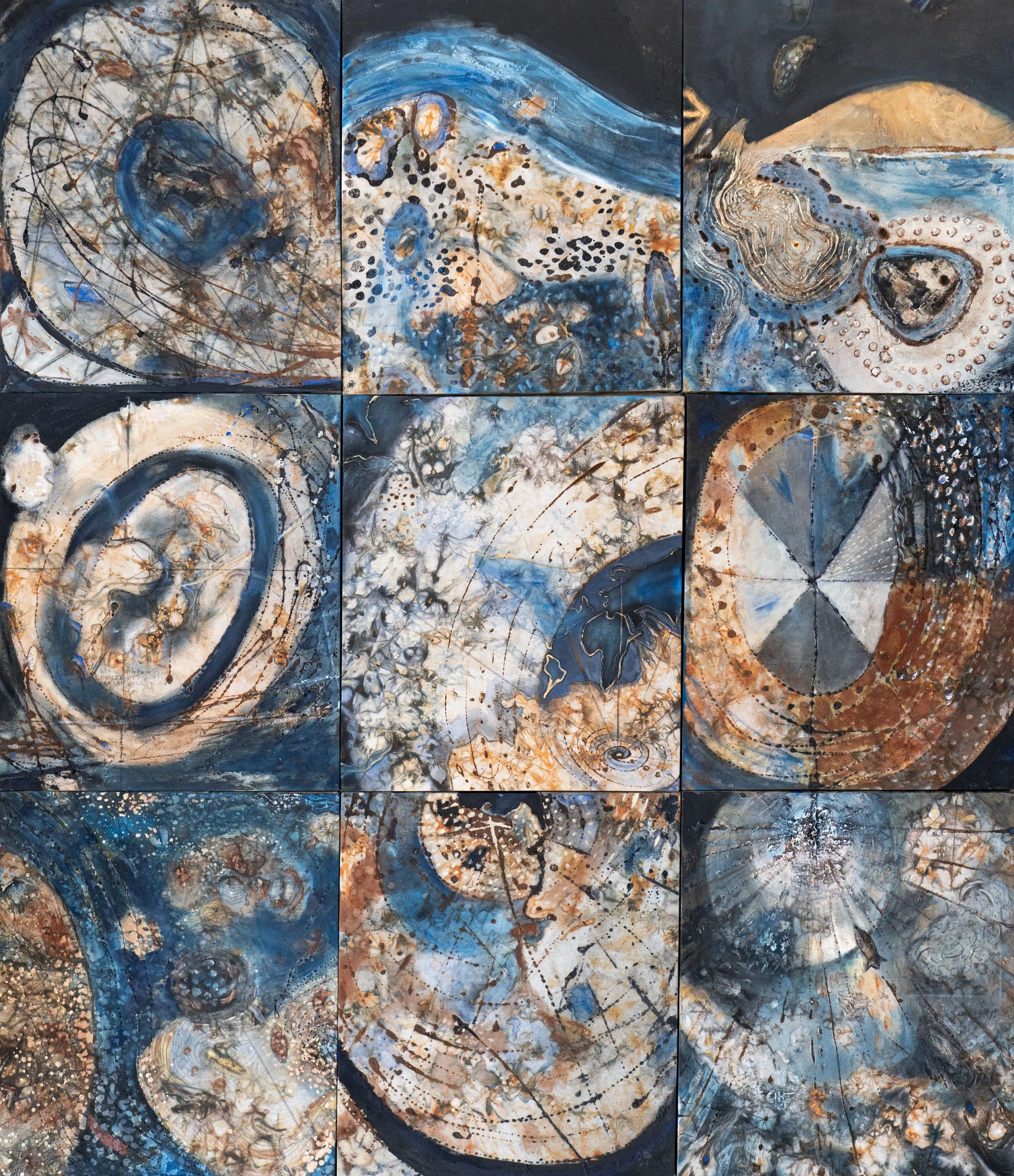
Arébénor Basséne, SIRIUS series #3, 2026, Acrylic, natural pigment, wax, graphite and sawdust on batik, 210x180 cm. Photo: Khalifa Hussein
Selebe Yoon is pleased to announce its participation in Frieze London 2026, Booth F31 in the Focus Section with a solo presentation of Arébénor Basséne’s recent works.
Drawing from the Dogon knowledge systems and cosmogonies, Senegalese artist Arébénor Basséne projects celestial and territorial realms onto the canvas. By shifting between a bird's-eye view and the microscopic details of matter, he captures both the macro and micro dimensions of the Sahel and the Atlantic while looking back on Ptolemy and the 12th-century cartographer al-Idrisi to chronicle the possible Worlds as cartographies, inviting contemplation of origin, travel and ties between earth and sky. As for the Dogon, the universe holds multiple worlds and endless stellar domains; the first and most precious star to shine is Sirius, Sigi Tolo, which Basséne calls to guide the onlookers of his works, a continuum of imaginary vignettes or maps. Intertwined to the oceans or Sahara’s sand, silhouettes and faces or even topographies emerge from the surface, gradually built from wood shavings, gum arabic, sand and natural pigments. By using arabic gum, Basséne uses a material central to colonial trade’s dark past, and still one of West Africa’s natural resources. These cartographies, while almost real, oscillate between imaginary and existing places. In the following display of the works, he transforms the booth into a projection, a cartography of the elsewhere.
“In Africa, astronomical knowledge is intertwined with theories about the invisible world, coupled with an oral tradition whose origins date back to Antiquity. This is all the more true because in Africa, there are no borders between the spiritual and science; everything is intertwined, the two are one, because everything is spirit.
Long before the first operational telescopes in 1862, ethnic groups all over the continent inherited astronomical knowledge from their ancestors, the mystery of which modern man is unable to unravel.
Among the Wolof of Senegal, Sirius is named SOR or SIBASSOR. On the other hand, among the Diola of Casamance, SIRITHIOR designates Sirius, and it is nothing other than the indigenous and authentic name of the city of Ziguinchor.
However, a little to the East, notably in Bandiagara, among the Dogon, Sirius B is named PO TOLO, while Sirius A is named SIGUI TOLO. Even if many ethnic groups agree in recognizing that their origins date back to ancient Egypt, it is clear that Dogon cosmogony remains one of the most intriguing and mysterious. In truth, it appears to be the most accessible, the most well-known, and the most understood cosmogony compared to Western ethnology or other anthropology.
Shouldn't the names that the ancestors of Africans attributed to the celestial bodies, the stars, and the cosmos push us to question this little-known field? Could these calendars, these maps, and these charters be ex-nihilo, that is to say, elements that fall from the sky? There is therefore reason to ponder all these questions that burn on our lips, pushing our imagination toward emotional labyrinths and spiritual vibrations that shake our ostentatious prejudices and preconceived ideas."
Arébénor Basséne
Frieze London
14 – 18 October 2026, The Regent’s Park, London
Opening Hours
Wednesday, October 14: 11am - 7pm (invitation only)
Thursday, October 15: 11am – 1pm (Members and Invitation only preview) 1pm – 5pm General admission tickets
Friday, October 16: 11am - 7pm
Saturday, October 17: 11am - 7pm
Sunday, October 18: 11am – 6pm