Fatim Soumaré: Djilor

Djilor
Fatim SoumaréNovember 6th, 2026– March 27th, 2027
Opening November 18, 2026 6pm-9pm
Alongside the 16th Dakar Biennale, Selebe Yoon is pleased to present "Djilor", Fatim Soumaré's first solo exhibition at the gallery, where the artist will unveil a series of seven new monumental textile works.
A village established on the banks of the Siin Delta in southern Senegal, where Fatim Soumaré lives and works, in Serer "Djilor" also means "to withdraw" or "to choose another place for oneself". According to oral tradition, the village’s founder first glimpsed the land in a dream. To help him find this place, a woman named Ndé Thioro gave him a spool of cotton she had spun by hand and by unwinding the thread, his path revealed itself. At Djilor’s origin, then lies a thread, always spun by women’s hands, connecting the dream to the soil and its many topographies.
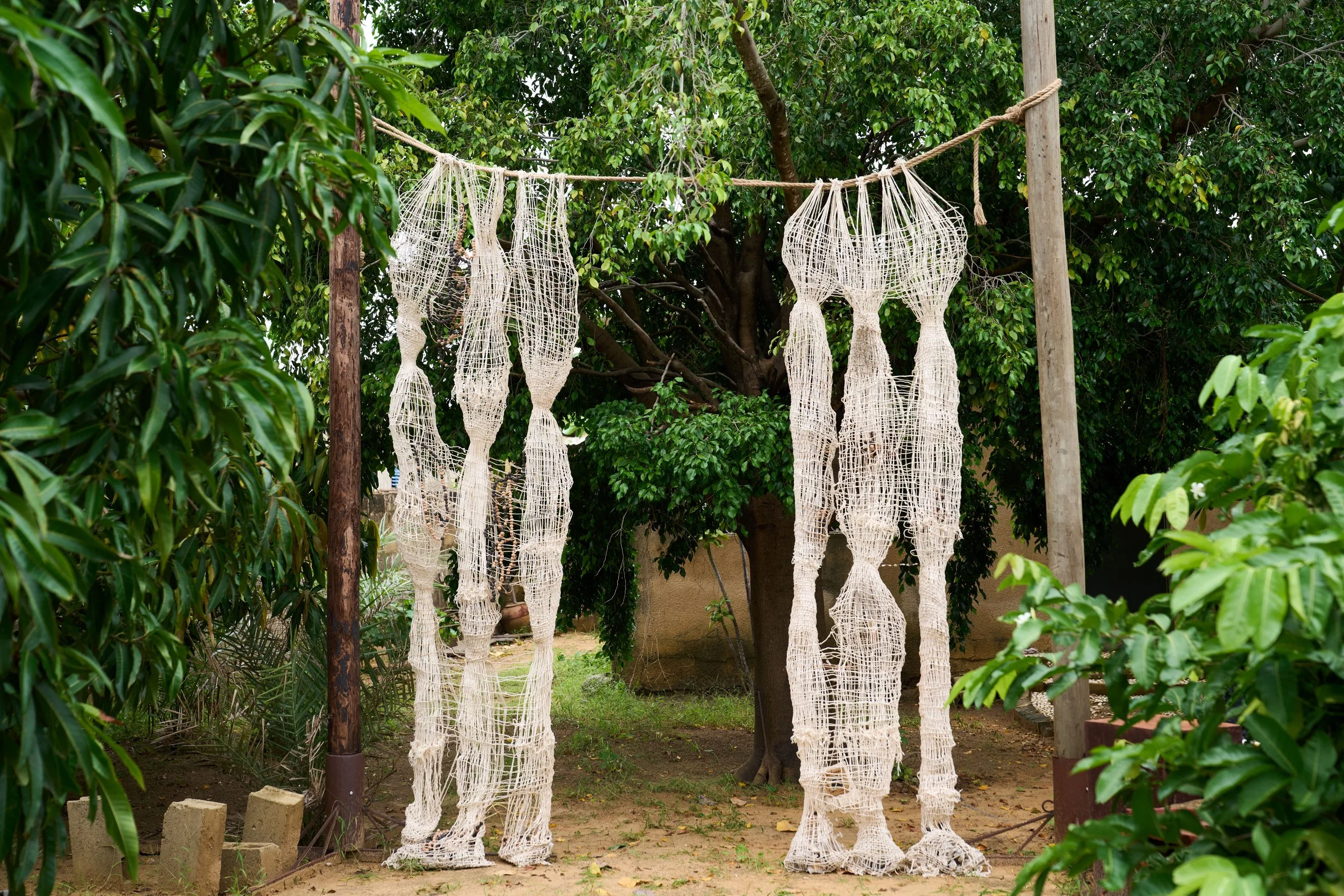
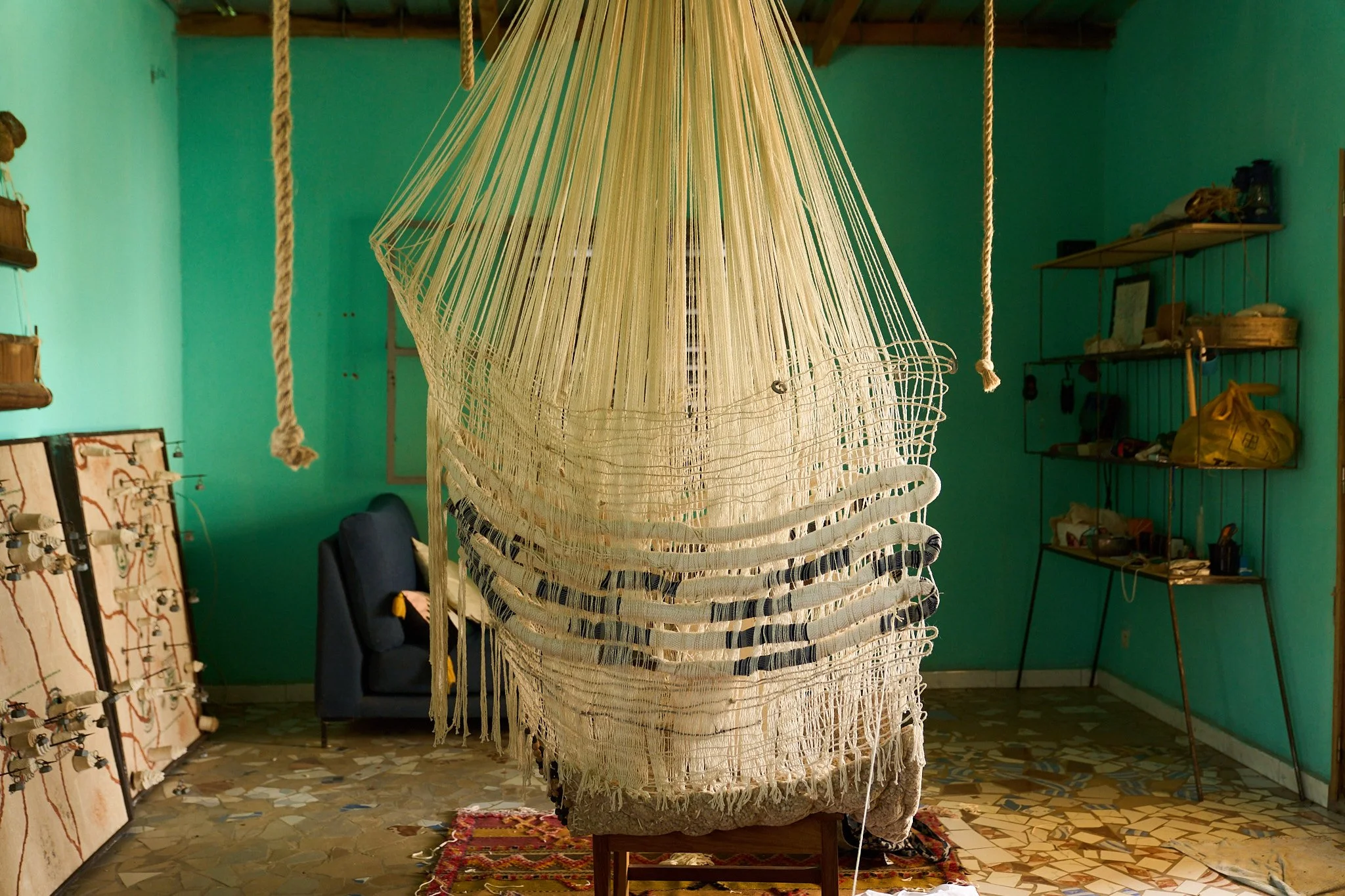
In between the building's columns rise seven monumental works composed of cotton and materials gathered along a journey extending from Cape Verde to the Maghreb, and as far as Brazil. Extended horizontally, the threads form seemingly endless vines, tracing an interwoven map that appears at once abstract and rooted in specific places. Objects bearing the gestures, techniques and knowledge of the places travelled punctuate the works: terracotta beads, seashells and oyster shells, metal spinning wheels and anchors used by fishermen in Ndangane, Senegal; bronze spouts from Ouagadougou, Burkina Faso; old manillas recovered at the port of Dakar—objects whose changing uses over time speak, in many ways, to the paradoxes of human history: first ornaments in the Kingdom of Dahomey, then currency in the transatlantic slave trade, then restraints around the wrists and ankles of enslaved people, and later tools for handling cargo; sand from Gabès, Tunisia; fish scales from the waters of Itaparica, Brazil; and wool offcuts from Amazigh carpets, shaped by the last artisan shearsmen of Khénifra, Morocco.
An ancestral practice that carries memory, weaving unfolds in Fatim Soumaré's work as a shared language, a means of storytelling, and a metaphor for physical and social bonds. The artist probes the history of the cotton plant and its precolonial circulation across the African continent, particularly along trans-Saharan routes, as well as the vernacular practices and technocultural knowledge that developed around its transformation. She studies variations of the traditional loom, the social and symbolic functions attached to it, as well as the upheavals caused by the industrial exploitation of cotton and the consequences of globalized industrialization.
Evoking a succession of doors, the works in the exhibition "Djilor" map out an infinity of possible trajectories for visitors. As an architectural element, a door may mark the monumental entrance to a city, like the majestic Ishtar Gate; remain as a vestige of a vanished enclosure; signal passage into a sacred space; or embody intimacy, welcome and hospitality in the home. Yet Fatim Soumaré’s doors stand apart from any enclosure. Supple and permeable, sensitive to air movement and passing bodies, they neither close off nor defend a territory: they invite us to imagine a place where different geographies—whether tangible or imagined—could meet. From one work to the next, each threshold seems to herald a new one, maintaining the visitor in a perpetual zone of passage, in a continuous peregrination. From their monochrome appearances to their tangible fibers, Fatim Soumaré's works care for, protect, and repair past heritages and those that are only just being woven.
Like palimpsests, these works hold multiple places at once and retain traces of the journeys that shaped them: those of the objects composing them, the hands that helped create them, and the stories woven into them. Here, the thread crosses territories as much as it connects people. For the artist, it becomes a means to spark encounters, organize the exchange of knowledge, and ensure the survival of traditional craftsmanship. Each work is thus a vessel for shared histories, knowledge and experience.
© Text copyright: Jennifer Houdrouge
November 6th, 2026– March 27th, 2027
Artist’s biography
Fatim Soumaré
© Fatim Soumaré
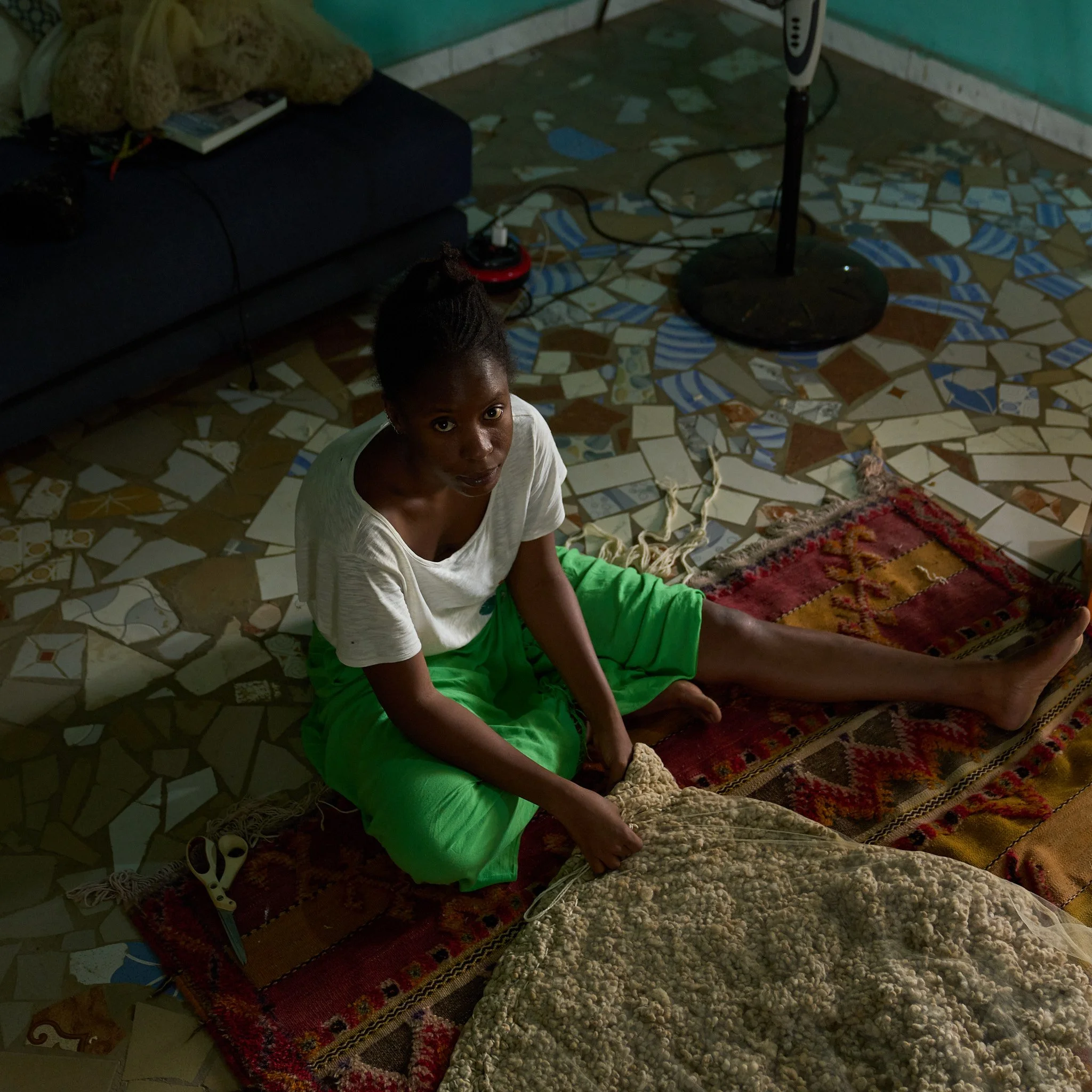
Fatim Soumaré is a Senegalese visual artist and researcher born in 1989 in Senegal and based in the Sine-Saloum region. Her work is rooted in the traditional textile crafts of West Africa, which she discovered through her mother, a traditional dyer. Her artistic practice focuses on socio-cultural and cultural methods of transmitting vernacular knowledge, which she explores through woven sculpture, immersive installations, video and performance. Fatim Soumaré's work highlights the importance of maintaining and evolving traditional crafts in contemporary contexts, making a significant contribution to Senegal's rural ecosystem.
In 2021, Fatim founded Falé, a collective of 200 craftswomen, and set up a workshop-laboratory dedicated to research on cotton. This initiative examines the transformation of cotton over time, as a common thread for reflections on the divergent transmutations of our modern societies.
In 2024, Soumaré studies Arts of Fiber and Textile at Atelier Aux Fils de l'Arz, Peillac in France. Her work has featured in solo exhibitions: Resurgence of the Oasis [The Caravans Road], Centre d’art La Boîte, Tunis, Tunisia (2025), The antique dealers, Pinda Lodj Market, Mar Island, Mar Lodj, Senegal (2024), Lam we nu kawuluxe [The griot's descendants], OFF Dak’Art, Agence Trames, Dakar, Senegal (2024). She has a;so taken part in numerous collective exhibitions, such as, “Sympnea”, curated by Camille Lévy Sarfati, Selebe Yoon, Dakar, Senegal (2025), “Unbearable Border”, 4th Biennale Internationale de Sculpture de Ouagadougou [BISO], Ouagadougou, Burkina Faso (2025), “Deconstruction, Reconstruction”, Łódź International Tapestry Triennial, curated by Marta Kowalewska & Bukola Oyebode-Westerhuis, Central Museum of Textiles, Łódź, Poland (2025), “Campfire”, public space project Bonfire [Bålprosjektet] by Signe Domogalla & Lars Arstad, Utladalen National Park Center, Norway (2025), “Ndiaxass [Patchwork]”, curated by Torunn Skjelland & Samba Fall, Intercultural Museum, Oslo, Norvège (2024), “Yoonu ci biir [The Inner Path]”, Exploring Art, Teraanga, and Social Change, The Wellbeing Project, the Wellbeing Summit Dakar-Thiès curated by Mauro Petroni, Maurice Gueye Cultural Center, Tostan Inc, PARTCOURS 12, Rufisque, Senegal (2023), itinérant exhibitions “Sur le fil: de Dakar à Paris”, curated by Olivia Marsaud, Le 19M, Paris France and “Sur le fil” Le 19M-IFAN, Dakar, Senegal (2023), “ROOFOO (Intimate mix)”, Atiss Gallery, PARTCOURS 11, Dakar, Senegal (2022), “Fusion Vegetalis”, Centre Culturel Camille-Claudel, FITE - Textile Biennial, Clermont-Ferrand, France (2022).